
New USPS Postmark Rule: Hidden Deadline Trap for Mailed Documents

By: Jordan Gerheim  CEO – Outside Chief Legal LLC

The U.S. Postal Service has (very) quietly changed the rules on postmarks effective December 24, 2025, and it creates a new trap for simply mailed documents. The short version: the date you see in the postmark is now usually the date your mail is first processed at a regional hub, not the date you handed it to USPS (like we have come to know). That difference of a day or two can be the difference between “on time” and “late” for taxes, ballots, legal notices, and payments.

What Changed And Why It Matters 

Under the old system, a postmark usually tracked close to the day you dropped something in the mail because it was processed locally and quickly. Now, as USPS consolidates processing into large regional centers, mail can sit longer before it ever hits a sorting machine, which means the machine postmark can be days after you actually mailed it.

The new USPS rule clarifies that the official “postmark date” is the date of first automated processing at a USPS facility, not the date USPS first took possession of your envelope. If you drop a tax return in a blue box on April 15 but it is not processed until April 17, the machine postmark will likely show April 17, and that is what many agencies, courts, and counterparties may look at first.

Who Is At Risk?

This change affects anyone who still relies on paper mail to prove they met a deadline, including:

  • Taxpayers mailing federal, state, or local returns, extension requests, or payments that are deemed timely based on the postmark.
  • Voters mailing absentee or mail-in ballots in states that accept ballots postmarked by Election Day.
  • Businesses mailing time-sensitive legal notices (default notices, termination or non-renewal letters, demand letters) where contracts or statutes key off the mailing date.
  • Companies and individuals mailing checks for rent, invoices, insurance, or loans that incur late fees or penalties if “received after” a certain date but where the postmark is used in disputes.

Because the machine postmark can now lag the deposit date, a business that “did everything right” on the last day can still have a document show up looking late, forcing you into a proof fight you did not expect.

How To Protect Yourself Now 

To live safely with the new rule, treat the default machine postmark as unreliable for anything that truly matters. For time‑sensitive items:

  • Go inside the post office. Take your mail to the retail counter and ask for a “manual postmark” (sometimes called a hand cancel or local postmark). The clerk stamps your envelope with that day’s date, and this is free.
  • Get proof of mailing. Use Certified Mail or Registered Mail so you walk away with a dated receipt and online tracking that show the item was accepted by USPS on a specific date.
  • Use a Certificate of Mailing. For less money than Certified, a Certificate of Mailing gives you a stamped receipt showing what you mailed and when, which can be critical evidence in a dispute.
  • Mail several days early. Build in buffer time so even if processing is delayed, your postmark and delivery still fall within the deadline window.
  • Go digital when allowed. If an agency, counterparty, or court will accept e‑filing, email, or portal uploads, use those tools to avoid postmark arguments entirely.

Contract Language To Update Now 

This rule change is a good reason to tighten your contracts and policies around notices, payments, and deadlines. Work with counsel to consider language along these lines (example clauses, not legal advice):

  1. Clarify What “Mailed” Means

Example: “ ‘Mailed’ or ‘mailing’ means delivery of the item to the custody of the United States Postal Service, as evidenced by a USPS‑issued receipt (including manual postmark, Certificate of Mailing, Certified Mail receipt, or Registered Mail receipt). The parties agree that machine‑applied postmarks reflecting the date of automated processing at a regional facility shall not, by themselves, be conclusive evidence of the mailing date.”

  1. Require Reliable Proof Of Mailing

Example: “For all notices, objections, or payments that must be made by a specified date, the sending party shall use (a) USPS Certified Mail, Registered Mail, or Certificate of Mailing, or (b) a nationally recognized courier providing tracking and delivery confirmation. The sending party shall retain the receipt as evidence of timely mailing.”

  1. De‑Emphasize The Machine Postmark

Example: “Timeliness of any mailed item shall be determined by the date shown on a USPS counter‑issued receipt (including a manual postmark, Certified Mail receipt, Registered Mail receipt, or Certificate of Mailing), and not solely by the date appearing in any machine‑printed postmark or automated processing mark.”

  1. Permit Or Prioritize Electronic Delivery

Example: “Where permitted by law, any notice, demand, invoice, or statement required under this Agreement may be given by electronic means (including email or secure portal upload). Such notice shall be deemed delivered when transmitted without system‑generated error to the email address or portal designated by the receiving party.”

  1. Define When Notice Is Effective

Example: “Notices sent by USPS with appropriate proof of mailing shall be effective on the earlier of (a) the third business day after the mailing date shown on the USPS receipt, or (b) the date actual delivery is confirmed. Notices sent electronically shall be effective on the date sent, provided the sender retains evidence of successful transmission.”

Small tweaks like these can dramatically reduce disputes about whether a notice or payment was “on time” under your contracts in light of the new USPS practices.

Practical Steps For Business Owners 

For non‑lawyer business owners, some simple tips to help operationalize this:

  • Identify all situations where you rely on the mail to meet deadlines (taxes, licenses, notices to customers or vendors, insurance, loans).
  • Update your internal procedures so staff know: last‑minute items must go to the counter, not the blue box, and must use manual postmark plus a receipt‑based service for high‑risk mailings.
  • Talk with your CPA and attorney about whether any tax, compliance, or contract workflows need to change in 2026 to reflect the new rule.
  • Review and update your template contracts to tighten mailing, notice, and delivery provisions so the law matches how USPS actually operates now.

Our Corporate/Business Counsel Services

Our Litigation Services

Meet Our Team  | Contact Us

Outside Chief Legal LLC is a modern, forward-thinking law firm serving as fractional chief legal officers and outside general counsel for businesses and their owners. With over 200 years of combined litigation, in-house, general counsel and administrative legal experience, the firm delivers approachable, comprehensive counsel that blends legal expertise with practical business insight to help clients navigate ownership complexities with confidence. OCL is a trusted partner for founders, business owners, and leadership teams nationwide. Learn more about our firm, meet our team, or schedule a Risk-Free Strategy Session to talk with an attorney about how we can help your company.

Deal Structure Decoded: Asset Purchase vs. Stock Purchase for Growing Businesses

By: Jordan Gerheim  CEO – Outside Chief Legal LLC

Buying or selling a business is not just about the price. How the deal is structured can dramatically change taxes, liabilities, complexity, and even whether the deal closes. Understanding the difference helps business owners make smarter decisions and negotiate terms that actually fit their goals.

What Is An Asset Purchase?

In an asset purchase, the buyer acquires specific assets and assumes specific liabilities of the business, rather than buying the company itself. Typical features:

  • Buyer chooses which assets to buy (equipment, inventory, contracts, IP, goodwill) and which liabilities to assume.
  • Legal ownership of each asset must be transferred (bills of sale, assignments, new contracts, etc.).
  • The seller’s legal entity often remains in place to wind down or hold excluded assets and liabilities.

Why Buyers Like Asset Deals:

  • More control over which liabilities they take on.
  • Ability to leave behind unknown or undesirable obligations, subject to some exceptions in certain industries.

Considerations For Sellers:

  • May face double taxation in some structures for C corporations.
  • Need to address how sale proceeds are distributed and what happens to remaining liabilities and contracts.

What Is A Stock (Or Equity) Purchase?

In a stock purchase, the buyer acquires ownership interests in the company (stock in a corporation or membership interests in an LLC), rather than the assets directly.

Typical features:

  • The company remains the same legal entity, keeping its assets, contracts, employees, and liabilities.
  • Only the ownership of the entity changes hands.
  • Many contracts, licenses, and permits stay in place, though some may have “change of control” restrictions.

Why Buyers Might Prefer Stock Deals:

  • Simpler operationally in many cases: fewer individual asset transfers.
  • Easier to preserve contracts and relationships that might be hard to assign.

Considerations For Buyers:

  • They Effectively Inherit The Company’s History, Including Unknown Or Contingent Liabilities.
  • Greater Emphasis On Thorough Due Diligence And Strong Representations, Warranties, And Indemnities.

Key Differences Business Owners Should Understand

  1. Liabilities And Risk

Asset Purchase: Buyers can often avoid taking on certain debts or obligations, though some liabilities (for example, certain tax or employment obligations) may carry over by law.

Stock Purchase: Buyers generally step into the shoes of the company, inheriting its obligations unless specifically dealt with in the purchase agreement.

Takeaway: Buyers often favor asset deals for risk control. Sellers often favor stock deals for cleaner exits.

  1. Contracts, Licenses, And Customers

Asset Purchase: Contracts usually must be assigned, which may require customer or vendor consent. Some agreements prohibit assignment altogether or require renegotiation.

Stock Purchase: Contracts often stay put because the legal entity remains the same, though “change of control” clauses can still be triggered.

Takeaway: If key contracts or licenses cannot easily be assigned, a stock deal or hybrid structure may be more realistic.

  1. Tax Considerations (High-Level)

Asset Purchase: Buyers may get a “step‑up” in basis for purchased assets, which can provide favorable depreciation and amortization. Sellers, depending on entity type, may face less favorable tax treatment on some components of the sale.

Stock Purchase: Sellers often prefer stock sales for potential capital gains treatment and simpler tax reporting. Buyers may lose some tax benefits from not allocating price to specific asset classes.

Takeaway: The “best” structure can change once tax advisors run the numbers; legal and tax planning should be coordinated before terms are finalized.

  1. Complexity And Timing

Asset Purchase: More individual documents, assignments, and approvals, which can increase complexity and closing time.

Stock Purchase: Potentially fewer moving parts, but often more intensive due diligence and more detailed representations and warranties.

Takeaway: Both structures can be complex; the real question is where you want the complexity—on the front end of structuring and tax planning, or in diligence and post‑closing risk.

How Outside Chief Legal Helps With Deal Structure

Choosing between an asset purchase and a stock purchase is not one‑size‑fits‑all. It depends on:

  • The nature of the business and its industry.
  • The mix of assets, contracts, and licenses involved.
  • The tax profiles and goals of the buyer and seller.
  • The parties’ appetite for risk and post‑closing obligations.

Outside Chief Legal works with buyers and sellers to:

  • Evaluate the pros and cons of each structure for their specific deal.
  • Coordinate with tax and financial advisors so legal and tax strategies align.
  • Draft and negotiate clear purchase agreements, representations, warranties, and indemnity provisions to manage risk on both sides.

The goal is to structure deals that close efficiently, protect your interests, and set the business up for success after closing.

Our Corporate/Business Counsel Services

Our Litigation Services

Meet Our Team  | Contact Us

Outside Chief Legal LLC is a modern, forward-thinking law firm serving as fractional chief legal officers and outside general counsel for businesses and their owners. With over 200 years of combined litigation, in-house, general counsel and administrative legal experience, the firm delivers approachable, comprehensive counsel that blends legal expertise with practical business insight to help clients navigate ownership complexities with confidence. OCL is a trusted partner for founders, business owners, and leadership teams nationwide. Learn more about our firm, meet our team, or schedule a Risk-Free Strategy Session to talk with an attorney about how we can help your company.

The Cost of Ambiguity: How Unclear Contract Language Leads to Expensive Disputes

By: Jordan Gerheim  CEO – Outside Chief Legal LLC

Ambiguous contract language looks harmless until both sides discover they have very different ideas about what a clause means. That gap in understanding is often what turns an ordinary business relationship into an expensive dispute, strained partnership, and perhaps even litigation.

Courts can try to enforce the parties’ intent, but when the words are unclear, the process of interpreting a contract can require motion practice, discovery, and hearings on what the contract “really” means, all of which cost time and money.

Common Sources Of Ambiguity

Even careful drafters fall into patterns that create ambiguity:

  1. Undefined Key Terms: This is a big one. For example, phrases like “timely,” “prompt,” “standard,” or “material” with no definitions.
  2. Pronoun Confusion: Using “it,” “they,” or “their” when more than one party or concept is in play.
  3. Inconsistent Labels: Referring to the same party as “Company,” “Client,” and “Customer” in different sections.
  4. Copy‑And‑Paste Conflicts: Combining clauses from different templates without harmonizing definitions, effort standards, or timeframes.
  5. Silence On Important Processes: Leaving change orders, price adjustments, or renewals to informal understanding rather than written rules.

Each of these creates confusion and room for the other side to argue that the contract means something very different than you assumed.

Real‑World Style Examples Of Ambiguity In Action

Example 1: “Net Profits” With No Definition

Two partners sign a short agreement promising one of them “10% of net profits” from a new product line. The contract never defines “net profits.”

  • One partner calculates net profits after deducting overhead, salaries, marketing, and shared expenses.
  • The other believes only direct costs for that product line should be deducted.

Once the product becomes successful, this difference in interpretation leads to a dispute over tens of thousands of dollars. The missing definition becomes the centerpiece of the conflict.

Instead: Define financial terms precisely. List which revenues and which categories of expenses are included or excluded, and consider adding a simple example calculation as an exhibit.

Example 2: “Reasonable Efforts” vs “Best Efforts”

A technology vendor promises to use “best efforts” to complete an implementation by a certain date, but elsewhere the contract says the vendor will use “commercially reasonable efforts” to meet project milestones.

  • The customer argues that “best efforts” means the vendor must prioritize this project and add resources to hit the deadline.
  • The vendor insists that “best” and “reasonable” are effectively the same and delays are acceptable given other work.

The inconsistent standards make it hard to measure performance and easy to argue over what level of effort was required.

Instead: Choose one effort standard and use it consistently. If a higher standard is truly needed for a specific obligation, define what that means in practical terms (for example, “allocate additional staff as needed to meet the deadline, up to X hours per week”).

Example 3: Conflicting Termination Provisions

A services agreement says in one section that either party may terminate “for any reason on 30 days’ notice.” Another section says, “This agreement may not be terminated during the initial one‑year term except for material breach.”

  • When the customer’s business changes, they send 30 days’ notice to terminate after six months.
  • The vendor points to the one‑year clause and demands payment for the full year.
  • Both sides have text they can point to and a dispute follows.

Instead: Read the contract as a whole and fix contradictions before signing. Use cross‑references (for example, “subject to the initial one‑year term described in Section 3”) so all sections are aligned.

Example 4: “Delivery Within A Reasonable Time”

A distributor agreement states that products will be “delivered within a reasonable time after order.” No further detail is provided.

  • When demand is low, deliveries within 10–14 days feel fine.
  • When demand spikes, the buyer expects three‑day turnaround; the distributor believes four weeks is still “reasonable.”

Neither side can point to a specific timeframe, so each falls back on what “reasonable” means in their own business. The gap in expectations turns into lost sales, finger‑pointing, and potential claims.

Instead: Replace vague timeframes with specific ones (for example, “within five business days of receipt of order”) and, if needed, include different timing for standard vs rush orders.

Example 5: Undefined “Major Customers”

An employee’s non‑solicitation clause prohibits them from doing business with the company’s “major customers” for one year after leaving, but the contract never explains what “major” means.

  • The former employee believes it applies only to the top one or two accounts.
  • The company insists it covers dozens of customers they consider “major.”

The phrase becomes the focus of a dispute over the scope and enforceability of the restriction.

Instead: Replace subjective labels with objective criteria, such as “any customer who generated at least $X in revenue in the twelve months before termination” or “the customers listed on Exhibit A.”

Example 6: “Standard” or “Industry‑Leading” Service

A marketing services contract promises “industry‑leading SEO services” and “standard reporting,” but gives no details on reporting frequency, content, or performance metrics.

  • The client expects detailed weekly reports and clear ranking improvements.
  • The agency believes monthly summaries are enough and that rankings will fluctuate.

The vague promises provide little guidance on whether the agency met its obligations.

Instead: Pair marketing language with concrete obligations. For reporting, specify frequency, format, and basic contents. For performance, focus on process and deliverables (for example, number of campaigns, posts, or updates) rather than vague outcome guarantees.

How Outside Chief Legal Helps Avoid Ambiguity‑Driven Disputes

Many costly disputes stem from ordinary words used in unclear ways, not from exotic legal doctrines. Outside Chief Legal helps companies:

  • Spot vague or conflicting provisions in contracts before they are signed.
  • Translate business expectations into clear, enforceable contract language.
  • Build standard agreements and clause “playbooks” so your customer, vendor, and partner contracts speak the same language and manage risk consistently.

As outside general counsel, the goal is to reduce surprises, preserve relationships, and keep you out of avoidable disputes by getting the language right from the start.

Our Corporate/Business Counsel Services

Our Litigation Services

Meet Our Team  | Contact Us

Outside Chief Legal LLC is a modern, forward-thinking law firm serving as fractional chief legal officers and outside general counsel for businesses and their owners. With over 200 years of combined litigation, in-house, general counsel and administrative legal experience, the firm delivers approachable, comprehensive counsel that blends legal expertise with practical business insight to help clients navigate ownership complexities with confidence. OCL is a trusted partner for founders, business owners, and leadership teams nationwide. Learn more about our firm, meet our team, or schedule a Risk-Free Strategy Session to talk with an attorney about how we can help your company.

Red Flags In Vendor Agreements

By: Jordan Gerheim  CEO – Outside Chief Legal LLC

Vendor agreements can look routine, especially when presented as “standard terms.” Yet the details in these contracts often determine whether a vendor relationship supports your business or exposes it to unnecessary risk. Here are some common red flags to look for and practical guidance on how to respond.

One‑Sided Limitation of Liability

Many vendor contracts include a limitation of liability that caps the vendor’s exposure to a small amount (for example, one month of fees) while leaving your potential losses without a ceiling. This can be a serious problem if the vendor’s failure could disrupt your operations, damage your reputation, or expose you to claims from your own customers.

  • Red flag: Vendor limits its liability to a nominal amount but excludes nothing.
  • Better approach: Seek a higher cap (for example, 12 months of fees) or specific carve‑outs for data breaches, confidentiality breaches, IP infringement, or gross negligence.

Broad Indemnity: You Give But Do Not Get In Return

Indemnity clauses decide who pays when a third parties sue. A common issue in vendor agreements is a broad indemnity you owe to the vendor, with little or no reciprocal protection for your business.

  • Red flag: You must indemnify the vendor for almost anything connected to your use of the service, but the vendor does not indemnify you for its IP infringement, data security failures, employee or other misconduct.
  • Better approach: Narrow your indemnity to your own negligence or actual contract breaches and require the vendor to indemnify you for claims based on its technology, employees, and data practices.

Auto‑Renewal and Difficult Termination

Auto‑renewal (evergreen) terms are not inherently bad, but when combined with long notice periods, hidden increase in charges or limited termination rights, they can lock you into relationships that no longer make sense.

  • Red flag: Multi‑year terms that auto‑renew unless you give notice 60–90 days before the end of a term, with no termination for convenience.
  • Better approach: Shorter initial terms, reasonable notice periods, and the ability to terminate for convenience with notice, especially for critical services.

Vague Service Levels and No Remedies

If a vendor provides a critical service, such as software, payment processing, or logistics, vague performance obligations are a warning sign. Without clear service levels, you have little leverage when performance drops or fails.

  • Red flag: The agreement describes the service in marketing language but does not define uptime, response time, or support obligations.
  • Better approach: Add measurable service level commitments, credits, or other remedies when the vendor does not meet those standards.

Unclear Data Ownership and Usage Rights

For technology, marketing, or SaaS vendors, data is often one of your most valuable assets. Contracts that blur who owns data or how it can be used should be examined closely.

  • Red flag: Vendor claims broad rights to use or share your data, or the contract is silent on who owns customer or operational data.
  • Better approach: State clearly that you own your business and customer data, limit how the vendor may use it, and address return or deletion of data at the end of the relationship.

Overly Broad Confidentiality and Non‑Compete Style Restrictions

Confidentiality obligations are appropriate, but some vendor agreements go further and restrict your ability to work with other vendors or serve particular customers.

  • Red flag: Provisions that effectively function as non‑competes or exclusive arrangements, especially if not negotiated.
  • Better approach: Limit restrictions to what is reasonably necessary to protect true confidential information or a defined collaboration, and avoid unnecessary exclusivity.

One‑Sided Amendment and Assignment Rights

Some vendor contracts let the vendor change key terms unilaterally (often via an updated online policy) or assign the agreement freely, while restricting your ability to transfer the agreement in a merger or sale.

  • Red flag: Vendor may change pricing or core terms by posting a new version, and you have no right to object or exit.
  • Better approach: Require notice and, for material changes, a right to terminate. Ensure you can assign the contract in connection with a sale or reorganization of your business.

Outside Chief Legal Can Help

Most business owners and executives do not have time to dissect every clause in every vendor contract, but ignoring these details can be costly. Outside Chief Legal helps by:

  • Flagging one‑sided risk‑shifting terms before you sign.
  • Prioritizing which changes are worth negotiating based on your risk, leverage, and budget.
  • Creating playbook language and standard positions you can apply across vendors to keep your portfolio of contracts consistent.

Our role is to act as outside general counsel so you can move deals forward quickly with confidence while still protecting your business.

Our Corporate/Business Counsel Services

Meet Our Team  | Contact Us

Outside Chief Legal LLC is a modern, forward-thinking law firm serving as fractional chief legal officers and outside general counsel for businesses and their owners. With over 200 years of combined litigation, in-house, general counsel and administrative legal experience, the firm delivers approachable, comprehensive counsel that blends legal expertise with practical business insight to help clients navigate ownership complexities with confidence. OCL is a trusted partner for founders, business owners, and leadership teams nationwide. Learn more about our firm, meet our team, or schedule a Risk-Free Strategy Session to talk with an attorney about how we can help your company.

The Anatomy of an Enforceable Business Contract: Essential Clauses You Cannot Afford to Overlook

By: Jordan Gerheim  CEO – Outside Chief Legal LLC

Business contracts are the backbone of your relationships with customers, vendors, partners, and key employees. When they are clear and enforceable, they prevent disputes and protect your company if something goes wrong. When they are vague or missing key clauses, they can be very expensive “lessons.”

Here are some of the essential building blocks of an enforceable business contract and the clauses every business owner should understand.

Basic Ingredients Of An Enforceable Contract

Before you worry about specific clauses, your contract needs the fundamentals:

  • Clear identification of the parties and their roles
  • A definite offer and acceptance
  • Consideration (each side is giving or promising something of value)
  • Lawful purpose and no fraud, duress, or misrepresentation

If any of these are missing, even a beautifully worded agreement can be difficult or impossible to enforce.

Essential Clauses You Cannot Afford To Overlook

  1. Scope Of Work or Services

The scope of work explains exactly what is being provided, when, and to what standard. This is often where disputes start.

Good scope language includes and answers:

  • What is included and what is not
  • Deadlines, milestones, and deliverables
  • Responsibilities of each party

The clearer the scope, the less room there is for disagreement later.

  1. Payment Terms

Payment terms are more than the price. They should spell out:

  • Amounts, billing schedule, currency, responsibility for transaction fees and due dates
  • Late fees, interest, or other remedies for non‑payment
  • Invoicing process and acceptable payment methods

Tight payment language improves cash flow and gives you leverage if the other side stops paying.

  1. Term And Termination

Every contract should say how long it lasts and how it can end.

Key points:

  • Initial term and any automatic renewals
  • Termination for cause (for serious breach)
  • Termination for convenience (with notice)
  • What happens on termination (final payments, return of property, transition duties)

Without clear termination rights, you can end up stuck in a bad relationship or in a fight over how to exit.

  1. Limitation Of Liability

A limitation of liability clause caps how much either party can be sued for under the contract. It is one of the most important risk‑management tools in your agreements.

Common approaches:

  • Capping damages at a set dollar amount or at fees paid under the contract
  • Excluding certain types of damages (for example, lost profits or consequential damages)
  • Carve‑outs for serious conduct (such as fraud, intentional misconduct, or some IP breaches)

Well‑drafted limitations prevent a single dispute from becoming business‑ending.

  1. Indemnification

Indemnification clauses state who pays if a third party sues because of the other side’s actions. These clauses can quietly shift enormous risk from one business to another.

Typical issues:

  • Who is indemnifying whom (and for what kinds of claims)
  • Procedures for notice and defense of claims
  • Whether the indemnifying party must pay judgments, settlements, and attorneys’ fees

Poorly worded indemnity language can leave your company paying for someone else’s mistakes.

  1. Confidentiality and Non‑Disclosure

Most businesses share sensitive information in the course of performing a contract: pricing, processes, customer lists, or other trade secrets. A confidentiality clause protects that information.

Look for:

  • What is considered “confidential information”
  • How it may be used and who may see it
  • How long confidentiality obligations last, even after termination

If your business relies on proprietary know‑how or data, this clause is critical.

  1. Intellectual Property Ownership And License

Any time content, software, designs, or other creative work is involved, you need clear rules on who owns what.

Key questions:

  • Who will own IP created under the contract?
  • Whether the other party receives a license to use it, and on what terms ?
  • How pre‑existing IP (each party’s existing tools, templates, or technology) is to be treated?

Without this clause, you can accidentally give away core assets or lose the right to use what you paid for.

  1. Dispute Resolution, Governing Law, And Venue

This is a big one for myself, a former full-time litigator, and it should be important to any party to a contract. (Our Litigation Services) Dispute resolution clauses control “how” and “where” disagreements will be handled.

Common elements:

  • Whether disputes go to court, mediation, or arbitration
  • Which state’s law will govern the contract
  • Where any lawsuit or arbitration must be filed

These provisions can dramatically affect cost and leverage in a dispute. You will also know how disputes will be handled before they occur.

  1. Force Majeure

A force majeure clause addresses what happens if an event beyond the parties’ control makes performance impossible or impractical (for example, natural disasters, major outages, government actions, or a Covid pandemic!).

A good clause:

  • Lists covered events or includes a sensible “catch‑all”
  • Explains what each party must do if such an event occurs (for example, notice and mitigation)
  • Clarifies whether obligations are suspended or the contract can be terminated

Recent years have shown how important it is not to treat this language as throwaway boilerplate.

  1. “Boilerplate” That Is Not Really Boilerplate

So‑called boilerplate provisions quietly shape enforcement:

  • Entire agreement (merger or integration clause) – confirms the written contract is the full deal
  • Amendment – requires changes to be in a signed writing
  • Assignment – controls whether rights and obligations can be transferred
  • Severability – keeps the rest of the contract in place if one clause is invalid

These short sections often decide whether a court enforces what your contract actually says or lets someone argue about side conversations and emails.

How Outside Chief Legal Can Help You In Your Contract Process

Most business owners do not need to become contract lawyers. What they need is trusted counsel to:

  • Translate legalese into practical risk and business terms
  • Spot one‑sided or missing clauses before the contract is signed
  • Negotiate changes that protect cash flow, limit liability, and keep disputes manageable

Outside Chief Legal serves as outside general counsel for growing businesses, reviewing and drafting contracts across vendors, customers, partners, and key hires. The goal is simple: contracts that are enforceable, practical, and aligned with how you actually do business.

Our Corporate/Business Counsel Services

Meet Our Team  | Contact Us

Outside Chief Legal LLC is a modern, forward-thinking law firm serving as fractional chief legal officers and outside general counsel for businesses and their owners. With over 200 years of combined litigation, in-house, general counsel and administrative legal experience, the firm delivers approachable, comprehensive counsel that blends legal expertise with practical business insight to help clients navigate ownership complexities with confidence. OCL is a trusted partner for founders, business owners, and leadership teams nationwide. Our team brings years of experience advising clients on entity selection, tax strategy, and the legal challenges that come with starting and scaling a business. Learn more about our firm, meet our team, or schedule a Risk-Free Strategy Session to talk with an attorney about how we can help your company.

Due Diligence Checklist for Buying a Small Business: Legal Issues That Can Make or Break Your Deal

By: Jordan Gerheim  CEO – Outside Chief Legal LLC

Buying a small business can be a fast path to growth, but a shallow due diligence process can turn a promising deal into an expensive mistake. Legal due diligence helps you understand what you are really buying and what risks come with it.

Choose the Right Deal Structure

Very early, decide whether you are buying the company itself (stock or membership interests) or its assets.

  • Asset purchases let you pick specific assets and often leave many liabilities behind, but may require third party consents and new contracts.
  • Equity purchases are usually simpler operationally but mean you inherit more of the company’s history, contracts, and potential liabilities and claims.

Check Corporate and Ownership Records

Confirm that the seller has clean authority to sell and that ownership is what they say it is.

  • Formation documents and amendments (articles, certificates, operating/LLC agreements, and bylaws).
  • Ownership records (cap table, stock ledger, membership interests, options, warrants).
  • Minutes, written consents, and key resolutions, including approval of the proposed sale.

Review Contracts, Leases, and Key Relationships

Contracts can often drive most of the value in a small business. Request to see:

  • Customer contracts, vendor and supplier agreements, and important partner relationships.
  • Commercial leases, including renewal options, assignment and sublease rights, and any personal guarantees.
  • Loan agreements, security agreements, and guarantees that could survive the closing.

Employees, Contractors, and HR Issues

Employment problems can follow you after closing if they are not identified and addressed. Obtain:

  • Employee list with roles, pay, and status (employee vs independent contractor).
  • Offer letters, employment agreements, noncompete and non-solicitation agreements, and contractor agreements.
  • Handbooks, policies, and any pending or threatened claims, grievances, or investigations.

Intellectual Property and Brand Assets

If the brand or technology is central to the deal, verifying intellectual property ownership is essential. Request and evaluate:

  • Trademarks, service marks, copyrights, patents, domain names, and key social media handles.
  • IP assignment agreements from founders, employees, and contractors to the company.
  • Licenses in and out, including software and technology licenses and any restrictions on assignment.

Licenses, Permits, and Compliance

Regulatory gaps can delay or even prevent you from operating after closing. Acquire and analyze:

  • Business, professional, and industry specific licenses and permits.
  • Evidence that the business is in good standing with state and local authorities.
  • Any regulatory audits, investigations, warnings, or consent orders.

Litigation, Insurance, and Other Liabilities

Legal due diligence should line up with financial review to capture the full risk picture. Obtain:

  • Summary of past and present lawsuits, arbitration, administrative actions, and demand letters.
  • Insurance policies (general liability, E&O, D&O, cyber, key person) and claim history.
  • Liens, UCC filings, and other security interests that affect assets you plan to buy.

Business Litigation and Disputes

How Outside Chief Legal Helps Buyers

A strong due diligence process is not just about collecting documents; it is about understanding which issues matter for your goals and using that information to shape price, structure, and protections in the purchase agreement.

Outside Chief Legal helps buyers:

  • Focus due diligence on the legal issues that matter most for the size and type of deal.
  • Spot red flags early enough to walk away, reprice, or require stronger protections.
  • Coordinate with your tax and financial advisors so legal structure supports the business case.
M&A and Transactions

Meet Our Team  | Contact Us

Outside Chief Legal serves as fractional or outside general counsel to growing businesses, handling deal strategy, legal review, and negotiation so owners and leadership can stay focused on running the company.

Outside Chief Legal LLC is a modern, forward-thinking law firm serving as fractional chief legal officers and outside general counsel for businesses and their owners. With over 200 years of combined litigation, in-house, general counsel and administrative legal experience, the firm delivers approachable, comprehensive counsel that blends legal expertise with practical business insight to help clients navigate ownership complexities with confidence. OCL is a trusted partner for founders, business owners, and leadership teams nationwide. Our team brings years of experience advising clients on entity selection, tax strategy, and the legal challenges that come with starting and scaling a business. Learn more about our firm, meet our team, or schedule a Risk-Free Strategy Session to talk with an attorney about how we can help your company.

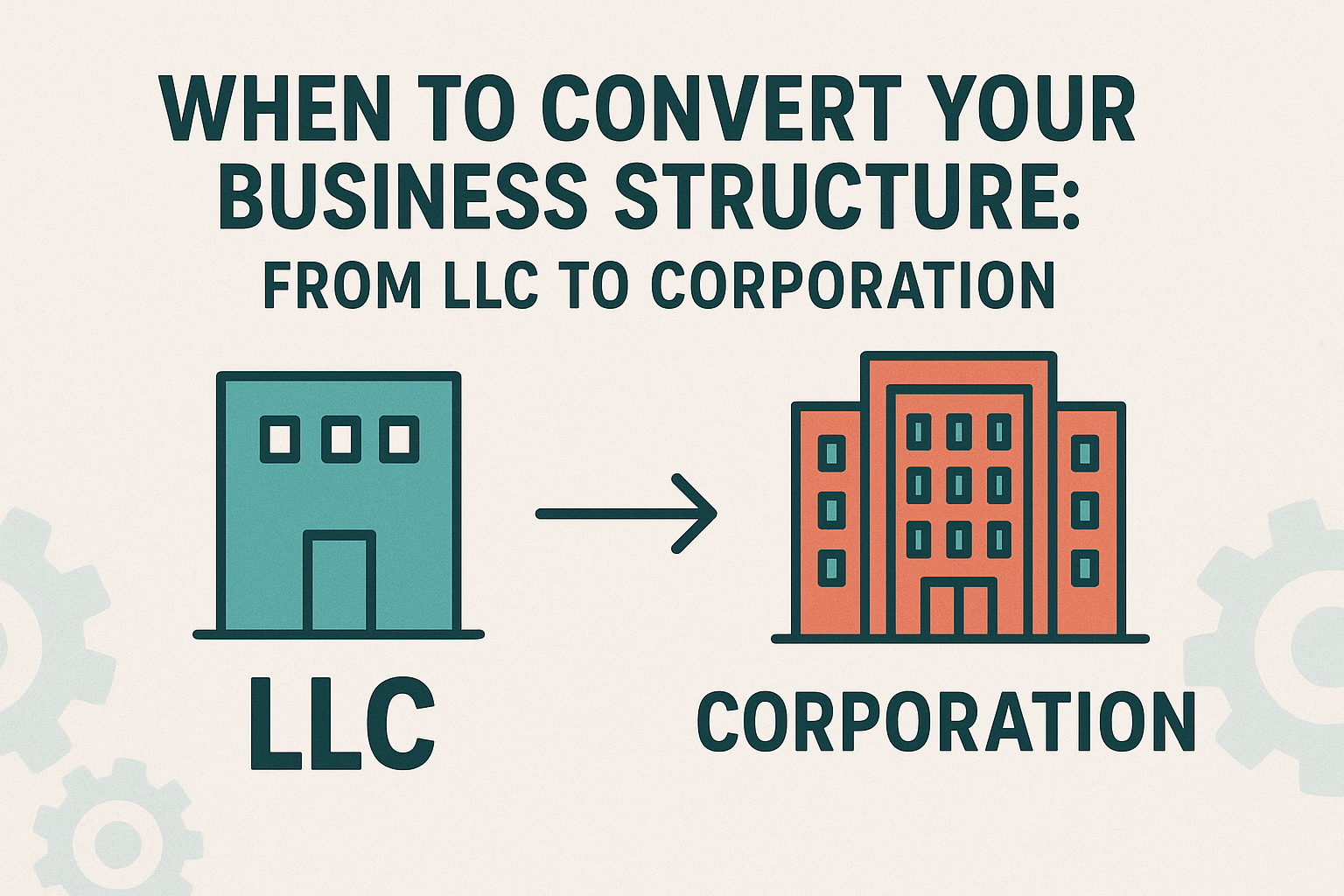
When to Convert Your Business Structure: From LLC to Corporation

By: Jordan Gerheim  CEO – Outside Chief Legal LLC

Many businesses begin as LLCs for simplicity, flexibility, and tax efficiency. But as your company grows, you may reach a point where converting to a corporation becomes the smartest move for long-term expansion, securing investment, or preparing for an eventual exit. Recognizing the signs that it is time to evolve your business structure is critical for continued growth and risk management.

Why Startups Favor LLCs Early On

LLCs offer easy setup, adaptable management, and pass-through taxation for owners. These features make LLCs ideal during the early stages when you want maximum control and minimum administrative burden.

The Signs It May Be Time to Convert

  1. You’re Seeking Outside Investors

Professional investors, including venture capitalists and most angel investors, prefer to invest in corporations, not LLCs. Corporations make it easier to issue and track shares, create stock option plans, and handle regulatory compliance.

  1. Offering Equity Compensation

Recruiting (or retaining) top talent often means giving team members equity. Formal stock option and incentive plans can be difficult to implement in an LLC and may lack the stock-based rewards that executives and key employees expect.

  1. Business Expansion and Multiple Owners

A growing business with multiple owners, especially those in different states or countries, often finds it simpler to manage and transfer shares within a corporation. S-Corporations and C-Corporations also allow better preparation for mergers, acquisitions, or IPOs.

  1. Planning to Go Public or Sell

If you have ambitions for an IPO, strategic sale, or major buyout down the road, a corporation is almost always required. Buyers and public exchanges expect strict governance structures and are often limited to acquired corporations.

  1. State and Tax Considerations

While LLCs are tax-advantaged in many cases, there are limits as business income increases. Converting to a C-corporation may provide tax planning opportunities, especially for reinvesting profits, and S-corporation status for eligible companies can further optimize your tax situation.

How (and When) to Convert

Changing from an LLC to a corporation is a significant legal and tax event. It requires proper documentation, careful planning, and sometimes state or IRS filings to transfer property, accounts, and contracts from the LLC to the new corporation. Early consultation helps you avoid triggering unintended taxes or compliance problems.

Switching from an LLC to a corporation is more than paperwork, it is a pivotal step in your company’s growth journey. If you see any of these signs arising in your business or want to explore the right moment to convert, our attorneys can guide you through the process, minimize risks, and position your company for future success.

Meet Our Team  | Contact Us

We combine legal experience with practical business advice to help founders, owners, and executives make the best decisions at every stage.

Outside Chief Legal LLC is a modern, forward-thinking law firm serving as fractional chief legal officers and outside general counsel for businesses and their owners. With over 200 years of combined litigation, in-house, general counsel and administrative legal experience, the firm delivers approachable, comprehensive counsel that blends legal expertise with practical business insight to help clients navigate ownership complexities with confidence.  OCL is a trusted partner for founders, business owners, and leadership teams nationwide. Our team brings years of experience advising clients on entity selection, tax strategy, and the legal challenges that come with starting and scaling a business. Learn more about our firm, meet our team, or schedule a Risk-Free Strategy Session to talk with an attorney about how we can help your company.
10 Potentially Critical Legal Mistakes New Businesses Make & How to Avoid Them

By: Jordan Gerheim  CEO – Outside Chief Legal LLC

Your first year in business is full of complex decisions. Many founders make preventable legal missteps that can threaten their company’s survival, sometimes before it even begins. Here are 10 key mistakes to avoid (and 10 examples of their potential fallout) if you want a strong foundation for growth.

  1. Failing to Create a Legal Entity

Some startups begin operating without forming any formal business entity. Running as a sole proprietorship or even a general partnership exposes founders to unlimited personal liability, tax complexity, and difficulty raising capital. Proper entity creation, such as an LLC or corporation, gives essential protection, credibility, and structure.  Let us help!

Ex: Three friends start a food delivery service but never register as an LLC or corporation. Two years later, a delivery accident leads to a lawsuit that puts their individual homes and personal savings at risk.”

  1. Choosing the Wrong Business Structure

Even when founders do create a legal entity, picking the wrong type (LLC, corporation, partnership, etc.) can result in higher tax burdens, riskier personal liability, or obstacles to growth. Consult an advisor to match your structure to your goals and to protect assets.

Ex: A startup picks a general partnership for speed and ease only to discover in tax season that they owe twice what they budgeted, and each founder is personally liable for a vendor dispute.

  1. Skipping Clear Founders’ and Operating Agreements

Without documented founder roles, equity splits, vesting schedules, and procedures for exits, startups invite confusion and disputes. Create operating agreements for LLCs and comparable documentation for partnerships and corporations.

Ex: Co-founders verbally agree on a 50/50 split but never document it. After a year, one tries to leave with company IP and half the revenues, launching a costly legal battle.

  1. Overlooking Employment Law and Worker Classification

Misclassifying workers (employees vs independent contractors), missing payroll taxes, or neglecting wage laws leads to fines and lawsuits. Every hire should be formally onboarded and in full legal compliance.

Ex: A company hires contractors instead of employees to save on costs, but state regulators reclassify (or correctly classify) them, resulting in back taxes and fines.

  1. Ignoring Intellectual Property Protection

Not securing trademarks, patents, copyrights, or trade secrets can allow others to copy essential assets, stalling your company and inviting legal trouble. Not including their protection in contractual relationships with internal and external partners. Assign, register and protect IP early.

Ex: A competitor registers a startup’s brand as a trademark first, forcing the business to rebrand after gaining early customer traction.

  1. Neglecting Licenses, Permits, and Tax Reporting

Operating without mandatory licenses or missing tax registrations results in shutdowns, fines or penalties (or not getting paid for work/services provided). Register as required and file timely reports, even with zero income.

Ex: An app developer launches a mobile app in several states but fails to collect or remit sales tax, facing penalties and emergency shutdowns. Ex No. 2: A contractor fails to obtain required licensure to provide work to homeowner. Dispute arises and homeowner files complaint with licensure board leaving contractor facing fines/penalties and likely not being paid for work done.

  1. Mixing Personal and Business Finances

Blurring boundaries by commingling accounts weakens liability protection and creates headaches at tax time. Separate and document all business transactions.

Ex: A founder pays business expenses from a personal account, resulting in messy records and a denied business insurance claim after a loss. They could also lose the protections of their “corporate veil” by failing to uphold the corporate formalities – including this one.

  1. Using Unvetted Online Templates for Contracts

Generic contracts often leave loopholes and may not comply with local laws. Professional review or customization helps secure enforceable agreements.

Ex: Founders download a free partnership contract online that does not comply with their state’s rules or their desired relationship, and later realize they cannot enforce crucial terms when a dispute arises.

  1. Overlooking Data Privacy and Website Requirements

Missing privacy policies and weak data protection exposes your business to disputes and fines, especially online. Early compliance safeguards your brand.

Ex: A subscription box service collects customer data but ignores privacy laws, leading to customer complaints and a regulatory investigation.

  1. Failing to Document Equity Grants and Secure Insurance

Without written equity agreements, future fundraising or founder exits create costly disputes. Operating without insurance exposes you to liability for claims, errors, or disasters.

Ex: A team member claims they own company shares promised in an email, but no signed agreement exists. So, a costly legal dispute stalls investment and distracts leadership.

Many founders wait too long to get legal counsel. Early advice helps reduce risk, save money, and lets you focus on growth. Outside Chief Legal helps startups nationwide avoid these preventable mistakes and build resilient businesses. Schedule a consultation or connect with our team to protect your startup and move forward with confidence.

Outside Chief Legal LLC is a trusted partner for founders, business owners, and leadership teams nationwide. Our team brings years of experience advising clients on entity selection, tax strategy, and the legal challenges that come with starting and scaling a business. We offer personalized guidance in LLC formation, incorporation, raising capital, and ongoing business compliance. Learn more about our firm, meet our team, or schedule a Risk-Free Strategy Session to talk with an attorney about the right structure for your company.

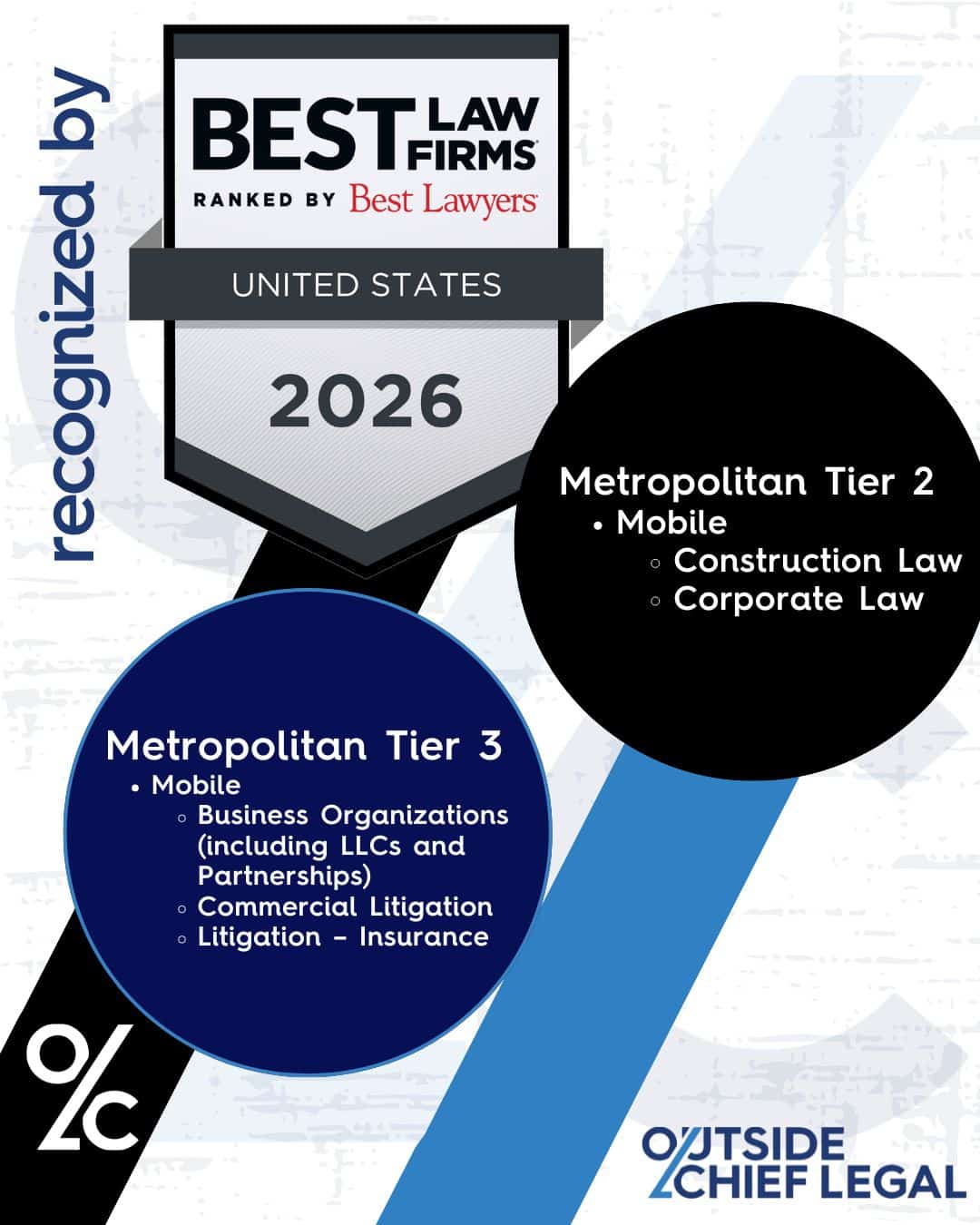
Outside Chief Legal Recognized among the 2026 Best Law Firms®

Recognition built on results.

We’re proud to announce that Outside Chief Legal has been named among the 2026 Best Law Firms®, earning recognition for our excellence, innovation, and client-centered approach.

⚖️ Metropolitan Tier 2 – Construction Law and Corporate Law

⚖️ Metropolitan Tier 3 – Business Organizations (including LLCs and Partnerships), Commercial Litigation, and Litigation – Insurance

This honor reflects more than rankings — it’s a testament to trust. To the businesses who rely on us, the peers who recognize our work, and the standard we set every day to redefine what legal partnership looks like.

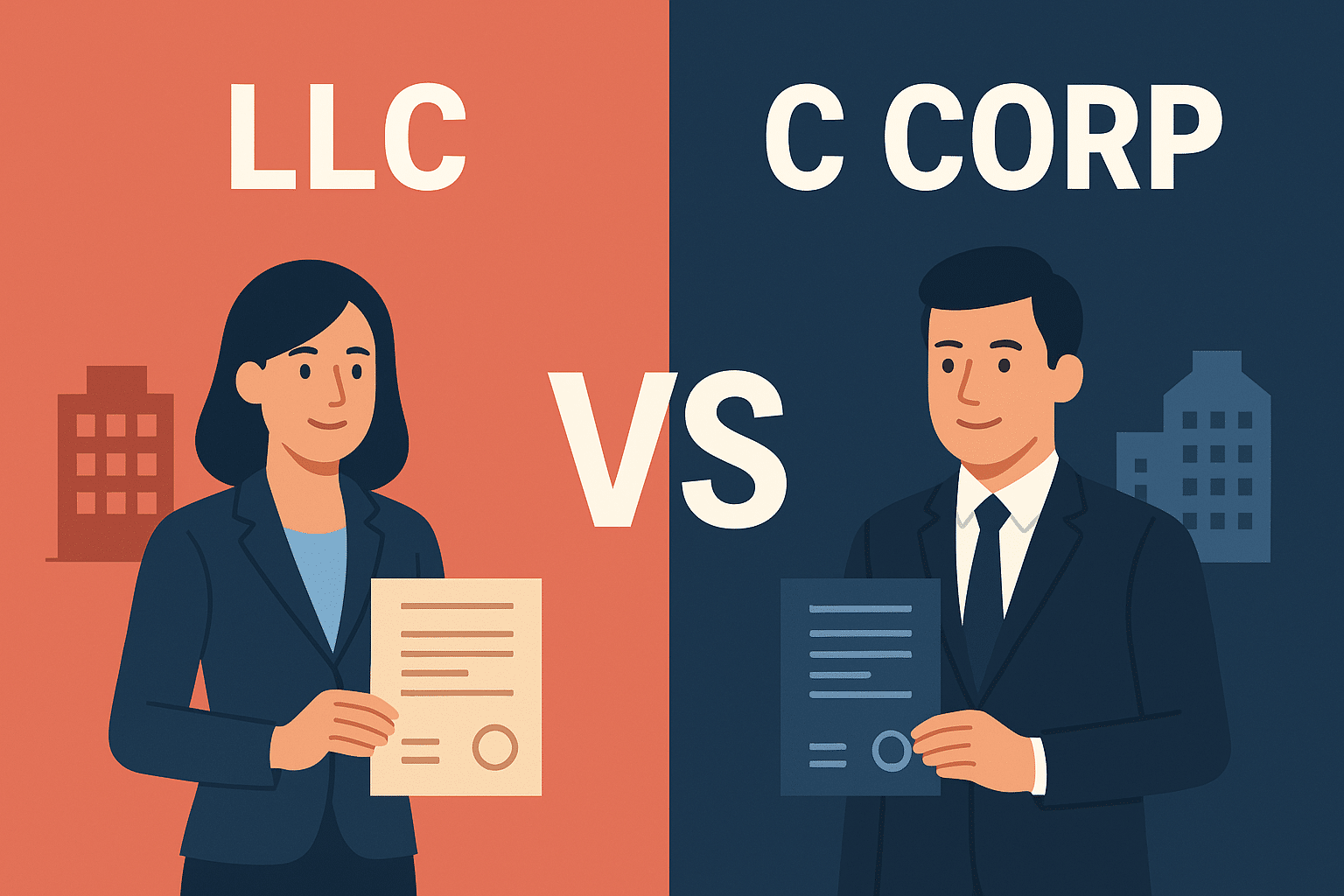
LLC VS. CORPORATION: The Right Choice For Long-Term Success

By: Jordan Gerheim  CEO – Outside Chief Legal LLC

Choosing the right entity is one of the most significant decisions for any business owner. The two most common options, a Limited Liability Company (LLC) and a Corporation, each offer distinct benefits between them in terms of taxes, liability protection, and scalability. Understanding these differences is important to building a business structure that supports your goals now and in the future.

Why Form a Business Entity To Begin With

To begin with, establishing a business entity serves two (2) fundamental purposes for business owners: liability management and taxation. First, creating an entity separates personal assets from business obligations, helping shield owners from liability for debts, lawsuits, or other business risks. Second, the choice of entity affects how the business and its owners are taxed, shaping everything from annual tax bills to options for deducting expenses, distributing profits, and planning for growth. Understanding these dual roles of an entity is the starting point for selecting the structure that best aligns with long-term business goals.

Tax Implications

Taxation is the fundamental distinction between LLCs and corporations.

By default, an LLC is a “pass-through” entity. Profits and losses are reported directly on the owners’ personal tax returns, avoiding corporate-level tax. Owners typically pay self-employment taxes on their share of income. However, an LLC can elect to be taxed as a corporation, which may provide flexibility for certain tax planning strategies.

A traditional C Corporation is a separate taxable entity. It pays corporate income tax, and then any profits distributed to shareholders as dividends are taxed again at the individual level (i.e. “double taxation”).

“My Business Is An S-Corp”

We hear this from business owners a lot. An S-Corporation or “S-Corp” is not a form of legal entity. It is a federal tax classification that eligible companies can elect with the IRS. Both LLCs and corporations can choose S-corporation status, provided they meet IRS qualifications (including a 100-shareholder limit, only one class of stock, and U.S. citizen or resident shareholders). S-Corp status enables a business to enjoy pass-through taxation, so profits are reported on owners’ personal returns, avoiding double taxation faced by C-Corporations. S-Corps can help minimize self-employment taxes in certain situations, but they come with restrictions on ownership and share structure, increased regulatory compliance, and potential state-level differences.  Should you elect S Corp status? Ask us for our S Corp Eligibility Guide

Learn more about tax strategy for your business with Outside Chief Legal (Business Tax Planning)

Liability Protection

Both LLCs and corporations provide limited liability protection, separating business debts and legal risks from owners’ personal assets. Under normal circumstances, both should limit the member or shareholder’s liability to their investments in the company.

LLCs: Owners (or “members”) are generally not personally responsible for business liabilities.  This protection covers debts, legal judgments, and claims resulting from business activities or employee actions, except in cases where an owner personally commits wrongdoing, guarantees a loan, or fails to maintain the LLC’s formal separation.

Corporations: Shareholders are also protected by limited liability, meaning their personal assets are generally shielded from the debts, obligations, and lawsuits of the corporation, again, except in cases involving fraud, co-mingling of funds, or other exceptions.

Corporate Formalities & “Piercing the Corporate Veil”

These protections are not absolute. If an LLC or C corporation fails to adhere to required formalities (such as keeping separate finances, maintaining proper records, and not commingling assets), or if the entity is used to commit fraud or injustice, courts can “pierce the corporate veil.” This results in ignoring the separate legal existence of the entity and holding the owners personally liable for the business’s debts or obligations. The principles and tests for piercing the veil are generally similar for LLCs and corporations, though specifics can vary by jurisdiction.

Maintaining corporate formalities and respecting the entity’s separate status is essential in both LLCs and C corporations to preserve liability protection for owners.

Understand liability protection and entity setup with Outside Chief Legal

Business Litigation Services and Risk Advice

Scalability and Growth Potential

Scalability is key for owners who want to grow, raise capital, or one day sell their business. Both entity types offer different advantages.

LLC Advantages: LLCs offer flexible management and minimal required administration, making them popular for small-to-midsize or closely held businesses.

Corporation Advantages: Corporations are preferred by venture capitalists, angel investors, and public markets. They can issue stock and make ownership transfers easier, supporting rapid or large-scale growth.

Many business owners start as LLCs for flexibility, then convert to corporations if their goals or needs change.

Which Is Right for Your Business?

Selecting your structure depends on your size, growth plans, industry, ownership needs, and readiness for compliance obligations. LLCs work well for flexibility, fewer formalities, and simple taxation. Corporations offer clear structures and are essential for ambitious growth and outside investment.

The optimal choice can change as your business matures. The decision benefits from a clear-eyed evaluation of legal, tax, and business planning considerations.

Our firm regularly helps business owners and leadership teams select and adapt the right entity for long-term success. If you are weighing your options or preparing for growth, our attorneys can guide you through each step to ensure you are protected and positioned for what’s next.

Outside Chief Legal LLC is a trusted partner for founders, business owners, and leadership teams nationwide. Our team brings years of experience advising clients on entity selection, tax strategy, and the legal challenges that come with starting and scaling a business. We offer personalized guidance in LLC formation, incorporation, raising capital, and ongoing business compliance. Learn more about our firm, meet our team, or schedule a Risk-Free Strategy Session to talk with an attorney about the right structure for your company.