


Summary
Alabama's new privacy law changes the answer for many Gulf Coast businesses. Here is whether your website needs a privacy policy now and what it needs to cover.
By: Jordan Gerheim, CEO – Outside Chief Legal LLC
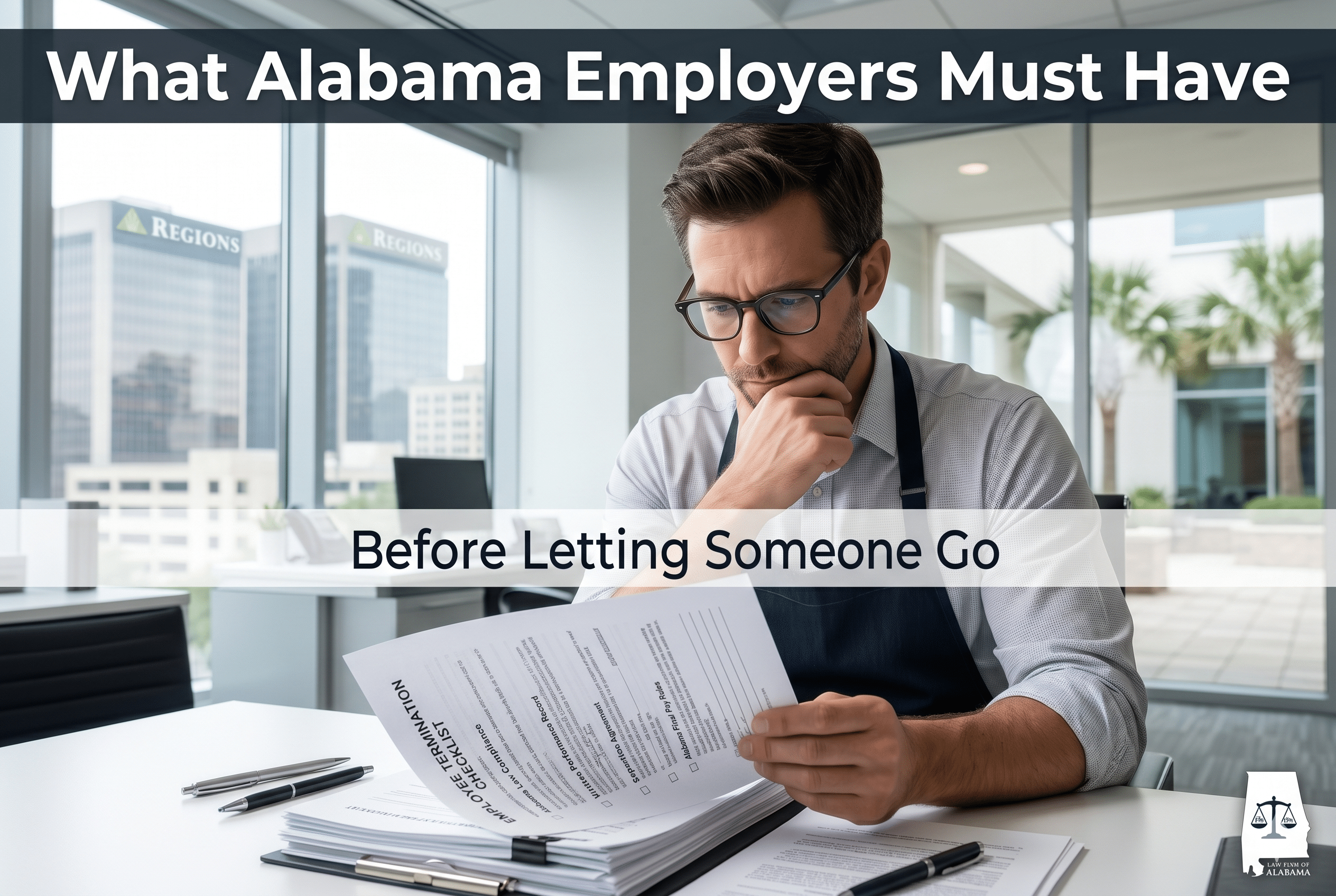
Terminating an employee is one of the highest‑risk moments in employment law. Alabama is an at‑will state, which means an employer can end the employment relationship at any time, for any reason that is not unlawful. That protection is real, but it has limits, and the documentation you have in place before the termination conversation largely determines whether those limits become a problem.
What At-Will Actually Protects and What It Does Not
At‑will employment means neither party needs a reason to end the relationship. The employer can terminate without cause and without notice in most situations. The employee can leave the same way.
The exceptions are what matter. Federal and Alabama law prohibit terminations based on protected characteristics including race, sex, religion, national origin, age, disability, and pregnancy. Federal law also prohibits retaliation against employees who engage in protected activity, including filing a complaint with the EEOC, reporting workplace safety violations, taking FMLA leave, or raising wage‑and‑hour concerns.
A termination that would otherwise be lawful under at‑will doctrine becomes vulnerable the moment it can be connected to one of those protected categories or activities. The employer does not need to have intended discrimination. If the facts allow an employee to draw a plausible connection between a protected characteristic and the termination, the claim has enough to survive initial review. What protects the employer at that point is documentation showing a consistent, legitimate business reason for the decision that predates the termination conversation.
A Clear Record of Performance or Conduct Issues
The most common employment claims that follow a termination are discrimination and wrongful discharge. In both cases, one of the employer’s strongest defenses is a documented, consistent record showing the reason for the termination.
If the termination is performance‑based, that record should exist before the final conversation. Written performance reviews, documented warnings, written counseling records, and records of prior conversations about the same issues all support a legitimate business reason for the decision. If the first documentation of performance problems appears in the file the day of the termination, it is far less credible than a record that shows a pattern over time.
Here is what the gap looks like in practice: a Gulf Coast business owner terminates an employee for chronic tardiness and repeated missed deadlines. The performance issues were real and had been discussed verbally multiple times over eight months. But nothing was in writing. When the employee filed an EEOC charge alleging the termination was discriminatory, the employer had no documentation to show the pattern of performance problems. The verbal conversations happened, but without written records, the employer’s account was their word against the employee’s. A single written warning issued after the first serious conversation would have changed that dynamic entirely.
Consistency matters as well. If you have terminated other employees for similar conduct, that record supports your position. If similarly situated employees have not faced the same consequences for the same behavior, that inconsistency will be noted and will be used.
Review the Employee’s File Before the Conversation
Before any termination conversation, review everything in the employee’s file. Protected class status is not relevant to the termination decision, but claims often follow when an employee in a protected class is terminated and the employer cannot clearly articulate why. If the employee recently filed a complaint, raised a workplace concern, took FMLA leave, or engaged in any protected activity, those facts need to be part of the legal review before you proceed.
Timing is one of the most scrutinized facts in retaliation claims. An employee terminated two weeks after filing an internal complaint has a much stronger retaliation argument than one whose termination is months removed from any protected activity. That does not mean you cannot terminate an employee who recently engaged in protected activity. It means the documentation showing the business reason needs to be clear, pre‑existing, and unambiguous.
A Written Separation Agreement When Appropriate
For terminations where the exposure is meaningful, a separation agreement with a release of claims is worth considering. The employee receives something of value, typically severance, in exchange for releasing their right to bring employment claims.
These agreements have specific legal requirements to be enforceable. The consideration must be something the employee is not already entitled to. For employees over 40, the Older Workers Benefit Protection Act imposes additional requirements, including a 21‑day consideration period and a 7‑day revocation window. The release must specifically cover the claims you need it to cover, and the language matters.
A separation agreement drafted correctly is a meaningful risk‑management tool. One downloaded from a generic source and filled in creates a false sense of protection. If the agreement is not enforceable, you have paid severance and received nothing in return.
Logistics Before the Conversation
Before the termination meeting, address the practical logistics. When will access to systems and facilities be revoked? How will company property be collected? What will the employee receive in their final paycheck, and when? In practice, employers in Alabama should provide final wages no later than the next regular payday following termination. Missing that timeline can create a separate wage dispute on top of whatever else the employee may be considering.
If there are non‑compete, non‑solicitation, or confidentiality agreements in place, review them before the meeting. Remind the employee of their ongoing obligations at the termination conversation and confirm those obligations in writing on the same day.
If the employee has access to sensitive client information, proprietary systems, or financial accounts, coordinate the access revocation before or immediately after the conversation, not days later.
The Conversation Itself
Keep it short, clear, and factual. This is not a negotiation, and it is not an opportunity for the employee to reverse the decision. Explain that the employment relationship is ending, state the effective date, cover the logistics, and close the meeting. Have a witness present. Document the conversation in writing promptly after it ends, while the details are current.
The employer who handles the termination conversation professionally, with documentation already in place and logistics already addressed, is in a materially stronger position than one whose process was emotional, inconsistent, or improvised under pressure.
If you are approaching a significant termination and want a legal review of your documentation and process before the conversation, a Risk‑Free Strategy Session is the right starting point. Getting that review before the meeting is far less expensive than responding to a claim after it.
No representation is made that the quality of the legal services to be performed is greater than the quality of legal services performed by other lawyers.
Our Corporate/Business Counsel Services
Outside Chief Legal LLC is a modern, forward-thinking law firm serving as fractional chief legal officers and outside general counsel for businesses and their owners. With over 200 years of combined litigation, in-house, general counsel, and administrative legal experience, the firm delivers approachable, comprehensive counsel that blends legal expertise with practical business insight to help clients navigate ownership complexities with confidence. OCL is a trusted partner for founders, business owners, and leadership teams nationwide. Learn more about our firm, meet our team, or schedule a Risk-Free Strategy Session to talk with an attorney about how we can help your company.
