


Summary
This post covers four signs an Alabama business has outgrown its original legal setup: an outdated operating agreement, undocumented employment decisions, a habit of signing contracts without review, and only involving a lawyer reactively rather than proactively. Each section includes a real-world consequence. Closes with a call to book a Risk-Free Strategy Session.
By: Jordan Gerheim, CEO – Outside Chief Legal LLC
The legal setup that worked fine when a business had one employee and one client rarely still fits once that business has ten employees, six-figure contracts, and name recognition in the Gulf Coast market. The business changed. The legal structure underneath it usually did not.
That gap is not always obvious from the inside. Revenue is up, the team is growing, and everything feels like it is working, which makes it easy to assume the legal foundation grew along with it. The problem is that legal structure does not fail loudly. It sits quietly in the background until a specific moment – a dispute, an acquisition conversation, an employee claim – puts pressure on exactly the part that was never updated.
Here are four signs that it did not keep up.
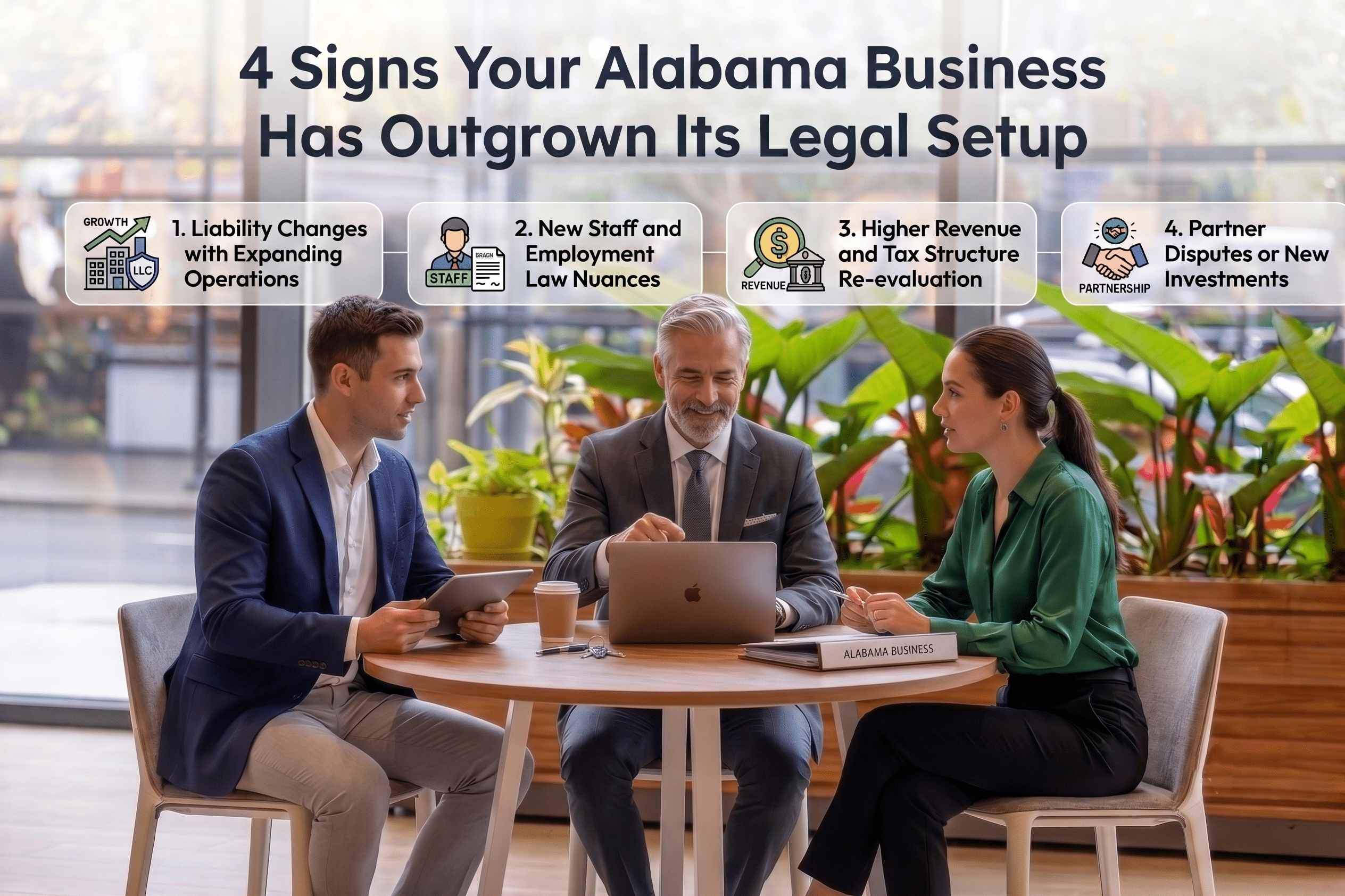
1. Your Operating Agreement Still Describes a Business You No Longer Run
An operating agreement written for a one-person startup or a two-person side venture rarely holds up once the business adds employees, additional owners, outside investment, or a second location. The agreement may still be legally valid, but it often stops describing how decisions get made, how profits flow, or who has authority over what.
A Mobile-based marketing agency started with two co-founders and a basic operating agreement drafted in an afternoon. Four years later, the agency had eleven employees, a third partner who joined through a handshake deal, and no updated agreement reflecting any of it. When the agency was approached about a partial acquisition, the buyer’s attorneys found that the ownership structure on paper did not match reality. The deal stalled for months while the business untangled who actually owned what – a problem that a periodic review of the operating agreement would have caught years earlier.
2. You Are Managing Employees Without Anything in Writing
A business with one or two employees can often get by on informal understandings. A business with a real team cannot, because informal understandings do not hold up when a termination gets questioned, a wage dispute surfaces, or an employee claims they were treated differently than a coworker.
The signs of outgrowing this stage usually show up quietly. Job offers that were never put in writing. Performance issues that were discussed verbally but never documented. Pay structures that vary from employee to employee without a policy explaining why. None of this is a problem until it is, and by the time it becomes a problem, there is no paper trail to point to.
A Baldwin County restaurant group grew from a single location to four locations in under three years, adding dozens of employees along the way, all without an employee handbook or written offer letters. When a manager was let go for performance reasons that were never documented anywhere, the business had no written record to support the decision beyond verbal recollection. The termination was contested, and the business spent significant time and legal fees defending a decision that was likely justified but impossible to prove without documentation.
3. Contracts Get Signed Because They Have Always Worked Out Before
Early on, many businesses sign vendor agreements, client contracts, and leases without much review because the stakes feel low and the relationships feel personal. That habit does not scale. A contract that carries minimal risk at a small scale can create real risk once the business is handling larger deals, more locations, or more complex vendor relationships.
The sign to watch for is not any single bad contract. It is the pattern of signing without review becoming the default, simply because it has not caused a problem yet. A business that has grown past its original scale but is still treating every contract the way it treated its first one is carrying more exposure than it realizes.
This shows up just as often with vendor agreements as it does with client contracts. A software subscription, an equipment lease, a supplier agreement. Each one seems minor on its own, but the terms in those agreements – auto-renewal clauses, liability caps, exclusivity language – accumulate across dozens of vendor relationships as a business grows. A business that has never reviewed any of them has no real picture of the total exposure sitting across its full set of agreements.
A Gulf Coast logistics company signed a warehouse lease using the same casual approach that worked when the business operated out of a single small unit. By the time the business had expanded into a much larger facility with significant equipment and inventory on-site, the lease still contained the same limited liability protections written for a much smaller operation. When a dispute arose with the landlord over responsibility for a facility issue, the business discovered its exposure was far higher than it should have been for an operation of its current size.
4. No One Is Advising You Before Decisions Get Made, Only After Something Goes Wrong
The clearest sign a business has outgrown its legal setup is not a specific document or a specific contract. It is the pattern of involving a lawyer only after a problem has already happened; a lease dispute, an employment claim, a contract disagreement – rather than before a decision is made.
A business at an earlier stage can often get away with reactive legal support because the decisions being made are smaller and the exposure is lower. A business that has grown past that stage is making bigger decisions more often, and each one carries more risk than the last. Without someone reviewing those decisions on the way in, the business only finds out where the risk was after it has already turned into a problem.
The cost difference between the two approaches is significant, even though it rarely shows up on a single invoice. Reviewing a contract before signing it, or getting a quick read on an employment decision before acting on it, is a short conversation. Untangling the same issue after it has already become a dispute is a much longer and more expensive one, and it usually comes with a business relationship or employee relationship already damaged along the way.
What Growing Past These Signs Looks Like
None of these four signs mean a business made a mistake getting to where it is. They mean the business has reached a size and complexity where the legal structure built at the start needs a real update, not a patch.
That update usually starts with a review, not a rebuild. That often means an updated operating agreement that reflects how the business actually operates, written policies covering employment decisions, a habit of contract review before signing rather than after a dispute, and a legal relationship built for ongoing input rather than emergency response. Each of these is a contained project on its own.
If any of these four signs sound familiar, that is a normal part of growth, not a red flag about how the business has been run. A Risk-Free Strategy Session with OCL is a practical way to see where the legal setup has fallen behind the business and get a clear picture of what it would take to close the gap.
No representation is made that the quality of the legal services to be performed is greater than the quality of legal services performed by other lawyers.
Our Corporate/Business Counsel Services
Outside Chief Legal LLC is a modern, forward-thinking law firm serving as fractional chief legal officers and outside general counsel for businesses and their owners. With over 200 years of combined litigation, in-house, general counsel, and administrative legal experience, the firm delivers approachable, comprehensive counsel that blends legal expertise with practical business insight to help clients navigate ownership complexities with confidence. OCL is a trusted partner for founders, business owners, and leadership teams nationwide. Learn more about our firm, meet our team, or schedule a Risk-Free Strategy Session to talk with an attorney about how we can help your company.
